For the app that keeps calling you back
Four lines of defense.
Taking the feeds off the phone ends most of the fight. But maybe one app in the store is still hard for you to put down. Everyone's is different. When yours starts winning, you have four answers, each firmer than the last.
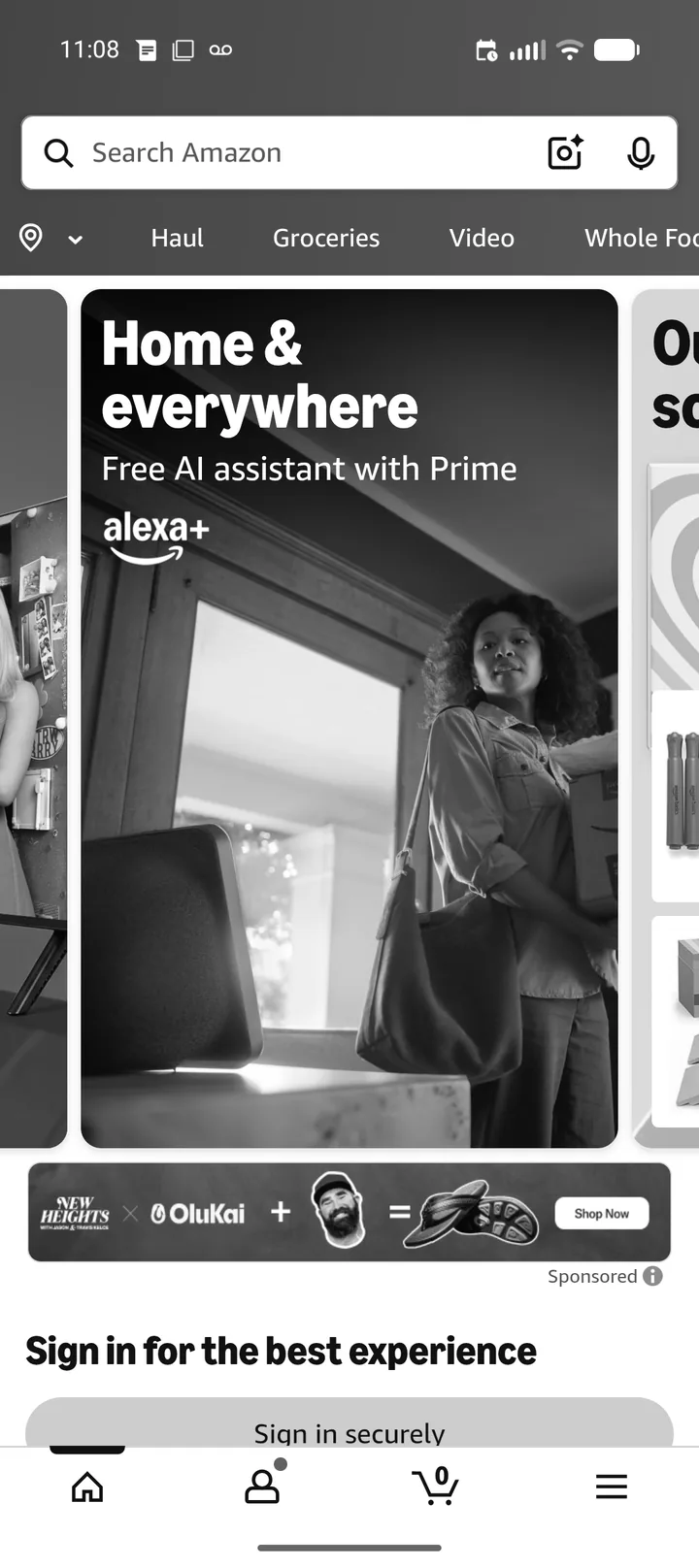
Take away its color.
An app without color loses real pull. In studies, when the whole screen went gray, people used their phones twenty to fifty minutes less a day, with nothing blocked. Gray out one app, a few of them, or the whole phone, and keep full color where you want it, like the camera and your photos.
Color comes back the moment you open something you kept in color, and it goes again when you leave. The camera, your photos, and the home screen start out that way, so the things you look at for their color keep it.
Nothing here is blocked. The app opens, works, and does everything it did before. What changes is how loudly it asks. A store is still a store in gray. It stops being a show.
The way back: one tap, any time.
Add a Second Thought.
A short breathing pause opens first, then one question: “what are you here for?” If you have an answer, walk right in. If you don't, that is worth knowing. A Second Thought never blocks you. It turns a reflex back into a decision.
You add one by holding down the app and choosing it. From then on, opening that app starts with a circle that grows and settles while you breathe, then the question, with a few plain answers to pick from. One of them is “I want to, and that's okay.” That one lets you in like any other.
The pause is short the first time. If you keep coming back the same day it gets a little longer each time, and tomorrow it starts short again. Choosing “never mind” puts you back on the home screen, without the app ever appearing behind it.
All of this happens on the phone. Nothing is counted anywhere else and nobody is told. Adding a Second Thought is instant; taking one off waits a day, and cancelling that wait, to stay as you are, is instant. Calls, messages, settings, and the camera can never carry one, so a moment that matters is never sitting behind a pause.
The way back: it never fully blocks, and turning it off takes 24 hours.
Set it aside.
Put an app out of reach for a time you choose. An hour, four hours, until tomorrow morning, or a full day. Once the time starts, there is no early unlock, and that is the point: you decide once, and you don't have to keep deciding all night.
You hold down the app, choose Set aside, and pick the window. Before it starts, the phone shows you the exact time the app comes back and asks you to hold the button to commit. That is your chance to change your mind, and it is deliberately the only one.
After that the app will not open from anywhere: not the home screen, not a notification, not a link someone sends you. You get a still screen with the time it returns, and then you get on with your evening.
A day is the longest you can choose. With no way out early, the horizon stays short on purpose. Some apps are never eligible either: calls and messages, banking, maps, health, and the tools that hold your passwords and your sign-in codes. Setting an app aside can never lock you out of your own life.
The way back: it opens again on its own, right on time.
Take it off the phone.
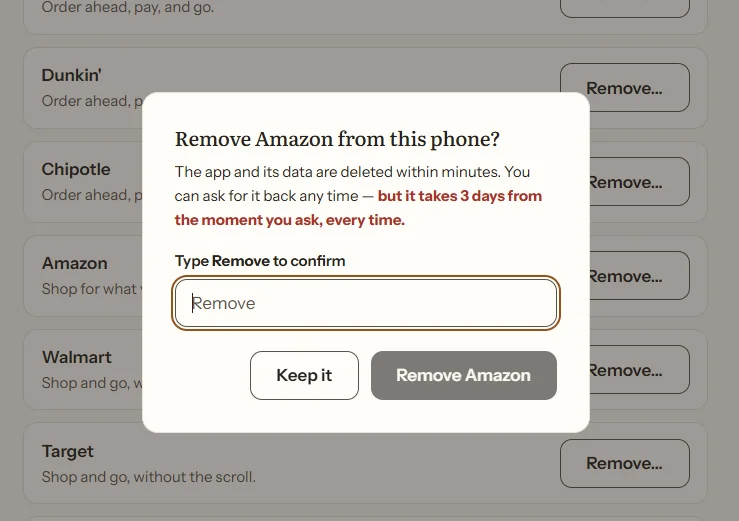
From your Adesse account at my.adessephone.com, remove the app from the phone entirely. It is gone in minutes. Getting it back takes three days from the moment you ask, so one hard night can't undo a decision you made with a clear head. Asking is free, and if the urge passes first, cancel the countdown and keep it gone.
You sign in, find the app in your list, and type the word to confirm. The app and its data are deleted from the phone within minutes, and it stops being something you can reach for.
Living off the phone is the other half of it. Undoing this takes a browser, a sign-in, and a decision made sitting down, which is not what a hand reaches for at eleven at night.
It is three days every time, the first time and the fifth. That is not a punishment and it is not a lock on you. It is distance you put in place while you were thinking clearly, still standing on the night you are not.
The way back: three days' wait, every time.
The idea underneath
The way back gets longer.
Every line ends on the same refrain, and the answer changes as you go down the page: one tap, then a day, then a window you set, then three days. The more a line can do for you, the more it costs to undo.
That is the whole design. Nothing here is permanent and nothing is hidden from you, but strength and ease of undoing move in opposite directions on purpose, so a decision made with a clear head outlasts a moment without one.
You choose which line you need, and you are free to stop at the first.